May 24, 2013

Architecture of Bus Stations in Serbia

Central Bus Station in Niš (picture from wikimapia)

I got inspired for this post by Yomadic's blog entry: http://www.yomadic.com/bus-from-belgrade-to-nis-serbia/ and his beautiful picture of the Niš Bus station.

Since in the Balkans, particularly in Serbia, Railway travelling was never so popular like traveling by bus, some Bus Stations got a lot of architectural attention when they were built.

I found pictures from some interesting Bus Stations and hope to expand this collection soon!


Niš Bus Station

Entrance of the Bus Station (picture wikimapia)
One of them is the Bus Station in Nis (Ниш) built in 1977 and one of the most modern Bus Station of the Socialist Federal Republic of Yugoslavia with 18 platforms. Nis-Ekspress AD was the main investor.

Ćuprija Bus Station

Bus Station in Čuprija


A lot of inhabitants of Ćuprija work as "Gastarbeiter" in Western Europe, so really lots of Bus Lines serve this little town. That explains the big Bus Station at the entrance of the town.
A close up shows the lamellar structure of the roof supported by precast columns arranged in a semi-circle.


Novi Pazar
A postcard from the 70's of Novi Pazar's Bus Station
Another interesting Bus Station  is the one in Novi Pazar built in the 1970's. The first time I visted Novi Pazar I was fascinated by it's frivolous architecture (read it in my post about Novi Pazar).

A newer picture on autobusi.net
The Bus Station fits in that style, and though it shows signs of age and people complain about its flaws it still looks charming.

Loving this combination: the bus station and his "soliter" a stand alone highrise building (from autobusi.net)


Zrenjanin

Zrenjanin Bus Station (from autobusi.net)

In Zrenjanin the Bus Station has a relief-like Fassade like in Niš. It/s not a big station, but with this detail it looks almost like an airport.

May 9, 2013

Communist Style Hotels 2

Hotel in Kolasin (Montenegro)


Last summer I posted about communist style Hotels in the Balkans with good example of state own Hotels built in the communist past. 

To the list of Hotels I'd like to visit I will add also these 6 eye-catcher:

Bianca Resort & Spa in Kolasin (Montenegro)


Bianca Resort in Kolasin: Jumbo Alpin Architecture


The Hotel also featured in this old postcard get my thumbs up for its appereance! (The main picture is from here


Hotel Merkur in Vrnjacka Banja

Vrnjacka Banja a Spa town in Central Serbia has a couple of cool buildings to offer. This is just one of it.
The garden side of the Hotel (Picture here)


The street side of the Hotel


Hotel Zubor in Kursumljska Banja

This building from 1982 is actually empty, as the country can not keep up with maintenance costs. 
Hotel "Žubor" in Kursumlijska Banja (picture from here)

Hotel Internacional Zenica (Bosnia and Herzegovina)

Hotel International Zenica (picture from here)
A masterpeace of a Hotel...and it still looks good today!


The Hotel today (picture from here)


Hotel in Vranjska Banja in Vranje

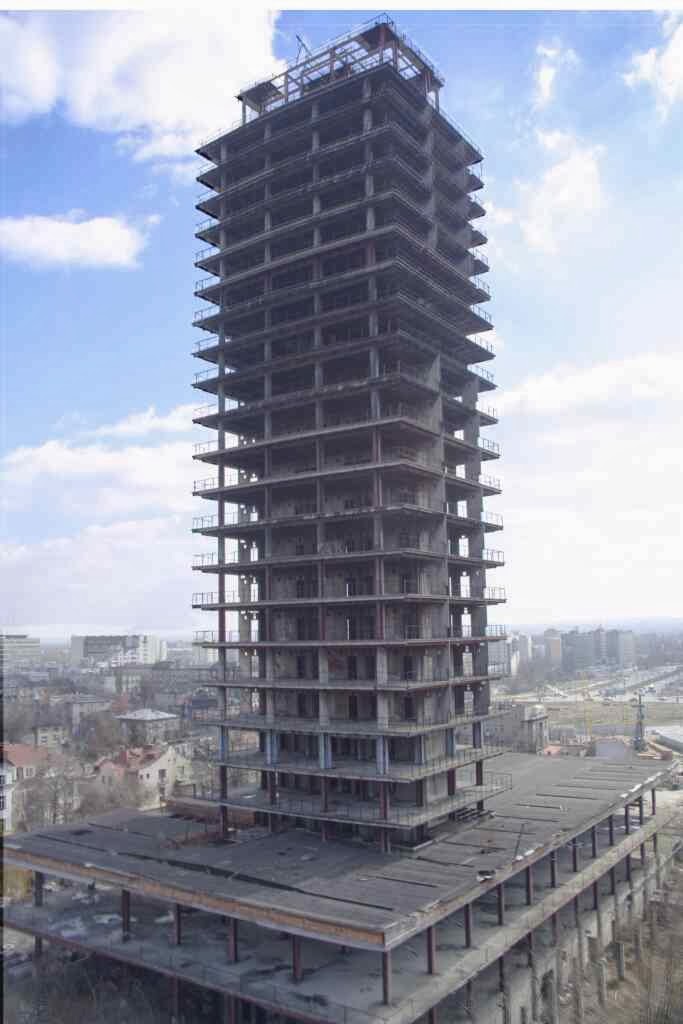
Unfortunately this one never got finished, started in 1973 it was about when the economical crises stroke the south of Serbia.


Just 50% completed (picture from here)

And at the end a little interior detail of a bathroom in Hotel Slavija in Belgrade

tile paradise (picture from here)


Links to other posts about interesting Hotel Architecture in the Balkans:


April 25, 2013

Interesting Architecture in Rogaska Slatina (Slovenia)

Hotel in Rogaska Slatina (street side)
Rogaska Slatina is a well known Spa in eastern Slovenia. Usually touristic pictures from Rogaska Slatina show some belle epoque clinics and wellness centers and would not really grab my attention. But when I ran into this old postcard from the 70's of Hotel Donat I became curious....

An new picture from Hotel Donat (garden side) from here
The Hotel still loos like a huge concrete boat and the brutalist facade was preserved. Just added housing technology and sunshades were added on the roof. Also the interiors have been renovated and is now a wellness Hotel (Grand Hotel Donat)

Cultural Center of Rogaska Slatina from here

Also the Cultural center of this Spa town got my attention: a cluster of octagonal buildings with mint green facades!  Rather daring but interesting!

A floor plan of the complex

In the Spa complex the medical center with the drinking hall (Rogaska Slatina is wellknown for its magnesium rich spa water) are another interesting buildings.
The overhauled condition of the structure needs a renovation but the starting situation is good: a neat modernist ensemble.
Maribor based architects from Styria Arhitektura d.o.o. made an inspiring suggestion in 2011 for a make over. A pergola and outdoor pools will be also added. I like that the existing vibe of the architecture will not be lost, it will be just slightly adapted.
What follows are the before/after pictures of the Styria architects (from the architects website):


Medical Center Rogaska Slatina today
Medical Center Rogaska Slatina proposition


See also a good renovation of a mid-century hotel in my post of Hotel Avala in Budva (Montenegro)

April 6, 2013

Stara Planina Mountains

Stara Planina

The Stara Planina (that means old mountains) is a part of the Balkan mountain range and lays in Eastern Serbia on the border with Bulgaria. The Balkan range runs 560 km from Vrška Čuka Peak on the border between Bulgaria and eastern Serbia eastward through central Bulgaria to Cape Emine on the Black Sea.

The Stara Planina is remarkable for its flora and fauna, and also with steep cliffs, the highest waterfalls in the Balkan peninsula and lush vegetation. 

Geologically, the Balkan Mountains is a 'young' part of the Alp-Himalayan chain which stretches across most of Europe and Asia. 


It can be divided into two parts: the main Balkan Chain and the Pre-Balkans to the north, which intrude slightly into the Danubian Plain. 


On top of the Serbian part is this rock called "Babin Zub" (Grandmother's Teeth).


The surrounding are part of a ski recreational area in winter and full of nice hiking trails in summer.


I just took a few pictures while cruising around. I arrived by night at Babin Zub's Hotel after a drive through dark roads and the navigation telling that theres nothing further along. I really had no idea were I landed. 


The next day I was surprised with a nice scenery while driving to see the newly errected just opened Hotel Stara Planina.


Also the new Hotel was a pleasant surprise, instead of an overstated giant facility with no relation to the surrounding, the building looks solidly adapted to the rough mountain setting from the outside and the interior is appropriately stylish.


After visiting the area in summer, I now would like to visit the area in winter. 

Eastern Serbian mountains are as beautiful as the Western Serbian mountain (I wrote about those mountains here in my posts about the unique National Park Tara "Best travel tips for Serbia - TARA/KOPAONIK" and "Tara National Park in Western Serbia", the Ethno Village Sirogonjo "Etno Selo - Sirogonjo", the posts about the Zlatibor region: "More Ethno in Zlatibor", "Mokra Gora" and Ethno Village Mecavnik "Kusturica made it!".


March 28, 2013

Temska a beautiful village of eastern Serbia

Temska

While traveling through Eastern Serbia I particularly loved some of the characteristic and soulful villages driving along smaller roads. Those villages are far enough from urban centers so they're totally quiet, but still near enough to benefit from trade oportunities and public infrastructure the cities can offer. Temska is one of those really picturesque villages without being too glamed up.  


Typical example of moravian style rural houses in Temska

 beautiful barns, traditional wood construction

Temstica river
 With around 900 inhabitants, a ground school, postal office, a few stores and a coffee shop it looks like a lively neat place along the Temstica River (a affluent of the Nisava River). 

Beautiful wood constructed barns with tile roof (and a couple of goats on Temska's streets)


Near the settlement there is a small hydroelectric plant and the small Monastery dedicated to the Holy Martyr Saint George called Temska Monastery.


Erected on ruins of a fortification of the 11th century, the monastery was built in the second half of the 16th century by the Dejanovic Family (nephews of Tsar Dusan).
 The Konak (Guesthouse) is beautifully restored

 The monasterie's dormitory and living quarters built in the 18th century represent an excellent example of the local folk architecture 

On the porch of the building various natural balm and balsams with curative effects and produced in traditional way from medicinal herbs of the Stara Planina are sold. People stop by to buy such balms for curing eczema, psoriasis, dermatitis, neurodermatitis, atopic dermatitis, skin allergies, acne, burnt skin, insect bits, hemorrhoids, varicose veins, alopecia, sinusitis, inflammation of the ears and open wounds. 


The Temska Monastery church has a three-nave basis with a semicircular altar apsis and a low eight-sided dome. The monastery church itself was constructed of white stone and covered by stone layers. In 1654 a vault was added above the narthex instead of the old wooden construction and the porch was painted with beautiful frescoes.

Iconostasis of Temska Monastery Church

 Temska Monastery cimetery


To give you some more information on village architecture in Serbia I post the links of my 6 Lessons on Serbian Rural Architecture

Lesson 1 in Traditional Serbian Rural Architecture
Lesson 2 in Traditional Serbian Rural Architecture:Style by Regions
Lesson 3 in Traditional Serbian Rural Architecture: The South Serbian Village
Lesson 4 in Traditional Serbian Rural Architecture:The Family Homestead
Lesson 5 in Traditional Serbian Rural Architecture: The Moravian House and its Interior
Lesson 6 in Traditional Serbian Rural Architecture: How does "new" rural architecture looks like?